Wind Classification
Timber Grade
Stud Height (mm)
Upper Floor Load Width (mm)
Upper Floor Joist Spacing (mm)
Roof Type
Maximum Roof Load Width (mm)
Select all inputs above
Select all inputs above to see results.
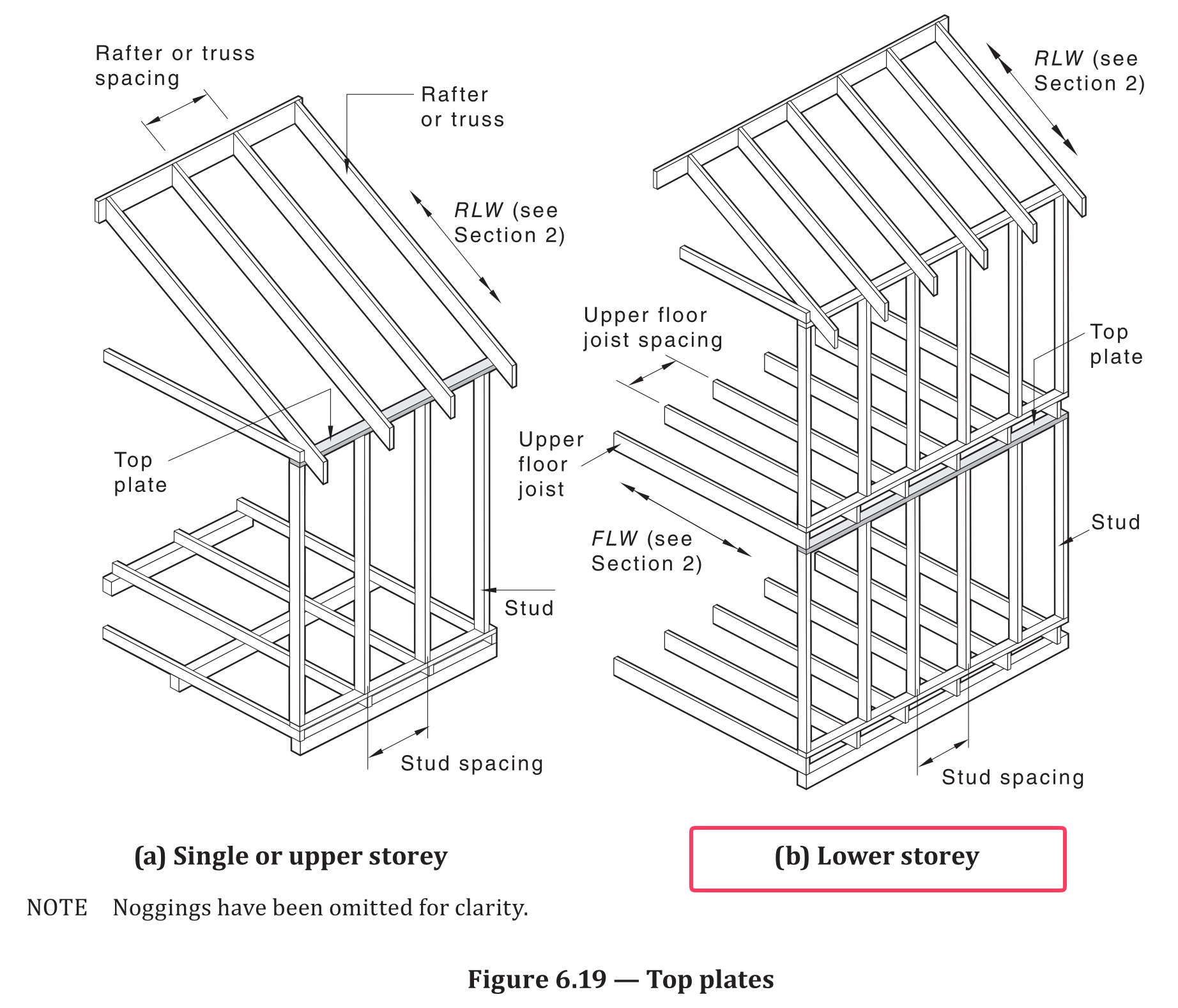
Table 46 Notes
- Maximum roof load widths are based on a maximum total sheet roof, framing and ceiling mass of 40 kg/m², a maximum total tile roof, framing and ceiling mass of 90 kg/m² and a maximum flooring mass of 40 kg/m². For guidance refer to Appendix A.
- Where floor joists are supported directly over studs or within 1.5 times the thickness of the top plate from the stud, the top plate may be a minimum of 35 mm deep.
- Where plates support concentrated floor loads, the load shall be supported directly over a stud(s) designed to carry the load (refer to Tables 38 or 39).
- Plates may be trenched up to a maximum of 3 mm.
- Multiple plates shall be nailed together as per Clause 2.5.
- For design parameters refer to Figure 6.19(b).
Engineering Disclaimer —
For preliminary assessment only. Verify all results with a suitably qualified structural engineer before use.
Always consult the current edition of AS 1684.2 and applicable building codes.
Structopedia accepts no liability for errors or reliance on outputs.
Clause reference: AS 1684.2 Cl. 6.4.3 · Table 46
Clause reference: AS 1684.2 Cl. 6.4.3 · Table 46