AS 1684.2 — Table 40
Jamb Studs
Lower storey of two storey — Upper floor load width 1800 mm — Cl. 6.3.2
Lower storey of two storey — Upper floor load width 1800 mm — Cl. 6.3.2
Wind Classification
Timber Grade
Roof Type
Roof Load Width — RLW (mm)
Results
| Size D×B (mm) | Stud Height (mm) | Max Opening Width (mm) |
|---|
Highlights passing sizes in green
Sizes meeting required opening width
Enter required opening width below
Figure 6.14 — Jamb studs — Lower storey
Show ↓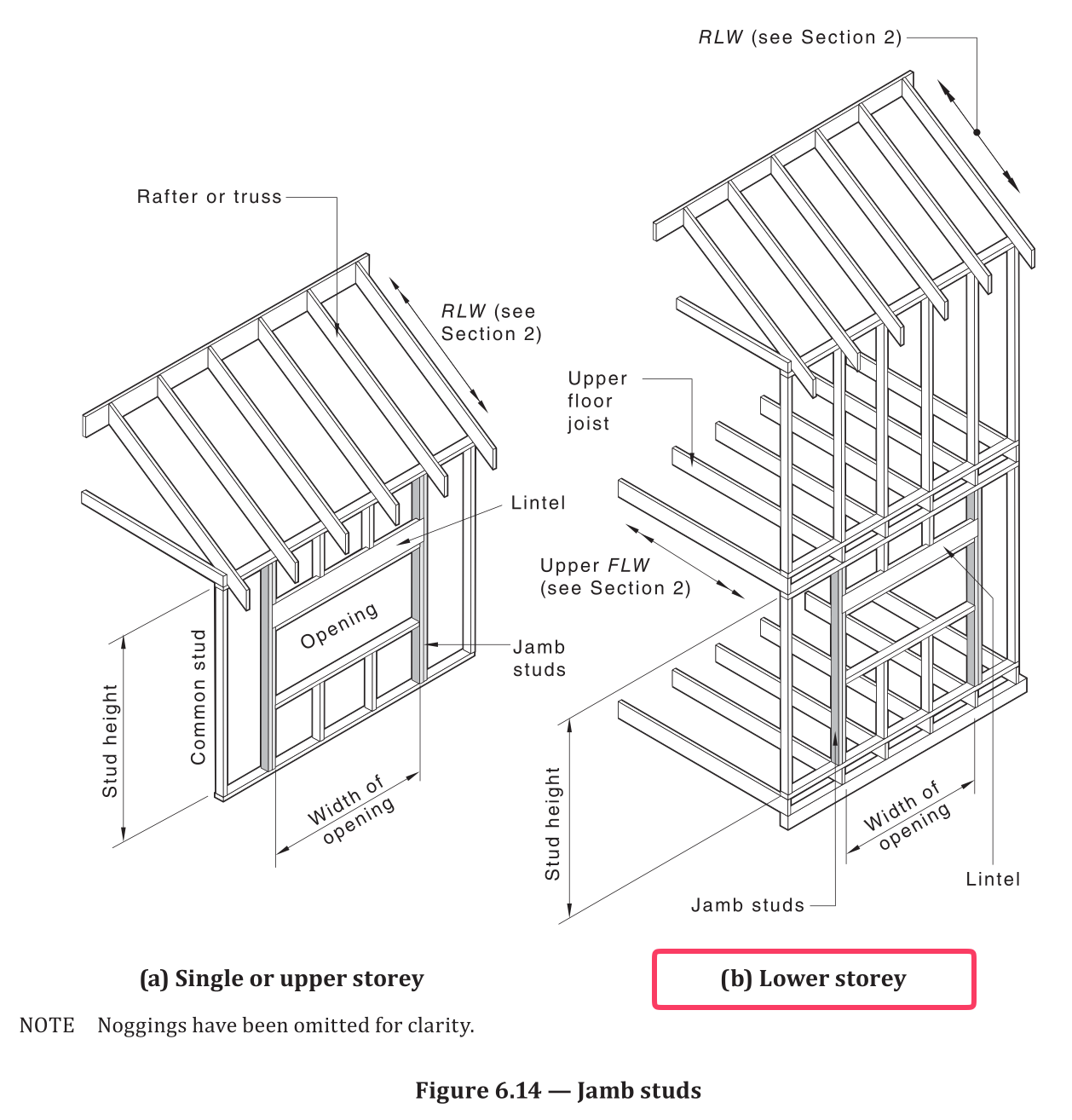
Table 40 Notes (AS 1684.2:2021)
- Maximum widths of openings are based on total sheet roof (framing + ceiling) mass of 40 kg/m², tile roof mass of 90 kg/m², and flooring mass of 40 kg/m². Refer to Appendix A.
- Upper floor load width is fixed at 1800 mm for this table. For FLW 3600 and FLW 4800 refer to Tables 41 and 42.
- Where jamb studs are required to support lintels that in turn support concentrated loads, additional jamb studs may be required — refer Cl. 6.3.2.3.
- A secondary jamb stud may form part of the total number of common studs required at the side of the opening.
- Multiple jamb studs shall be nailed together per Cl. 2.4.
- For design parameters refer to Figure 6.14.
- Jamb studs are not to be notched except as per Cl. 6.2.1.4.
- Mullion sizes shall be determined per Cl. 6.3.2.6.
- Where studs are used for tie-down, maximum tension load is 8.5 kN per stud or nail-laminated unit.
- NS = Not Suitable. Max width of opening capped at 4500 mm.
Engineering disclaimer:
These results are for preliminary assessment only. Verify all outputs against the current edition of AS 1684.2 and have designs confirmed by a suitably qualified structural engineer before use in construction or approval processes.