Wind Classification
Timber Grade
Floor Joist Spacing (mm)
Rafter / Truss Spacing (mm)
Roof Type
Maximum Roof Load Width (mm)
Select all inputs above
Select wind, grade, joist spacing, rafter spacing and roof type above.
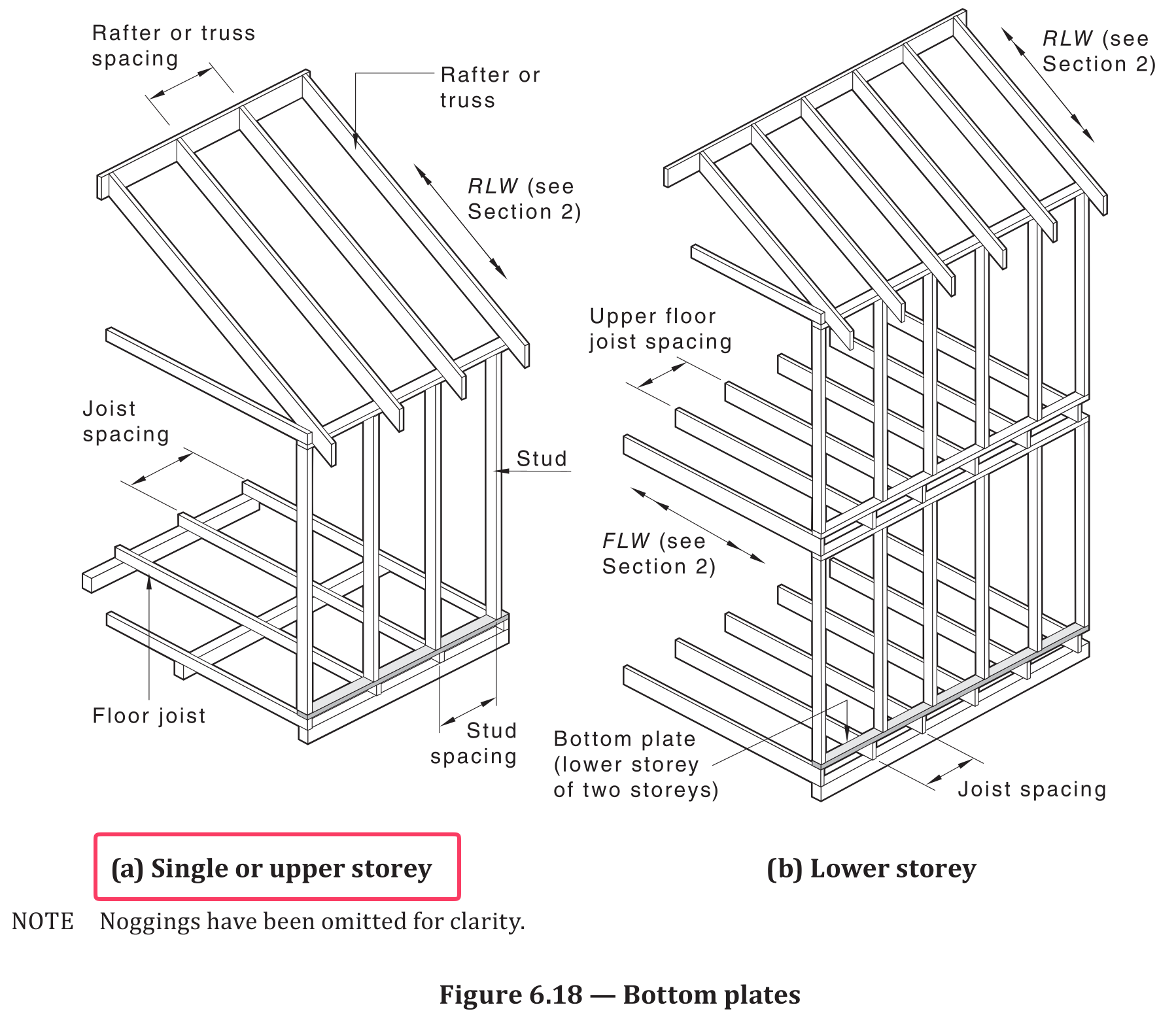
Table 14 Notes
- Maximum roof load widths are based on a maximum total sheet roof, framing and ceiling mass of 40 kg/m² and tile roof 90 kg/m². For guidance refer to Appendix A.
- Where the bottom plate is continuously supported by a concrete slab or solid nogging, or where wall studs are directly in line with floor joists, the bottom plate may be a minimum of 35 mm deep.
- Where bottom plates support studs supporting concentrated loads, posts or jamb studs, the load shall be supported directly over a floor joist or over solid blocking between plate and bearer.
- Plates may be trenched up to a maximum of 3 mm.
- Multiple plates shall be nailed together as per Clause 2.5.
Engineering Disclaimer —
For preliminary assessment only. Verify all results with a suitably qualified structural engineer before use.
Always consult the current edition of AS 1684.2 and applicable building codes.
Structopedia accepts no liability for errors or reliance on outputs.
Clause reference: AS 1684.2 Cl. 6.4.2 · Table 14
Clause reference: AS 1684.2 Cl. 6.4.2 · Table 14